Thursday, 28 August 2008

New Library and Civic Hall

At the meeting on Tuesday night Council moved on to the next stage of development of these exciting facilities, endorsing the concept plans for refurbishment and authorising the architects to proceed to detailed design. (Click on the images to enlarge)

The external appearance, for me, has visual elements of a book, a window to knowledge, and technology.

Cheryl Parrott, our Manager Library & Heritage has described the redeveloped Civic Centre Library and Hall as a focal point for the community. She describes it as providing an important social gathering point, offering a contemporary range of collections, facilities and innovative quality library, heritage and social services which support the intellectual, educational, cultural and social needs of the South Perth community. The facilities will be accessible and will be a welcoming place for people of all ages and backgrounds.

Tuesday, 12 August 2008

Como Beach Damage

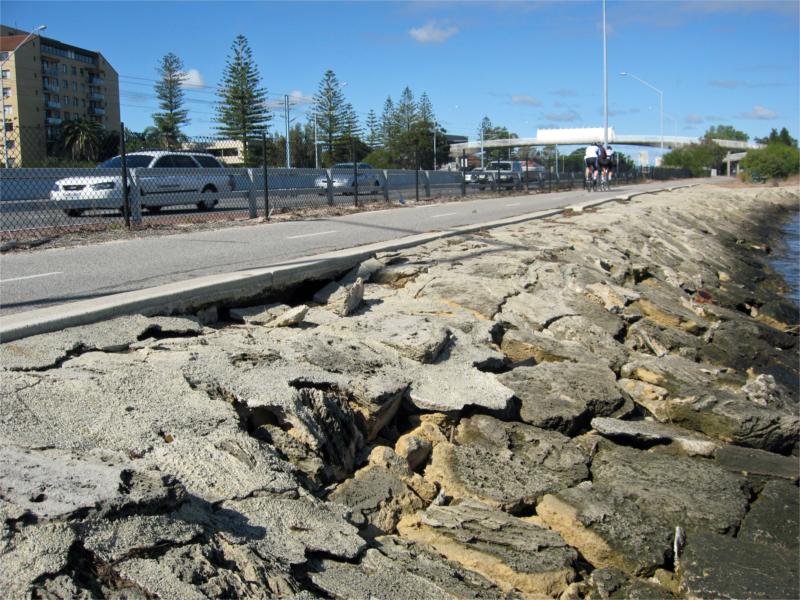
Recent storms have created more damage to the river edges along the freeway. This damage is mainly due to water from waves washing and pulling out large volumes of sand from underneath and behind protective structures. Erosion is working ever closer to the freeway.

While this seems at first to be an aesthetic matter for residents of South Perth, were damage to extend to the freeway there would be economic implications for the State of WA.

Here the sand beneath new pavement has been washed out, allowing recent works to collapse.

These pictures show clearly that the damage is not caused by impact, but rather by the extraction of supporting sand underneath limestone blocks and pavement.

The next area showing incipient damage is on the river edge next to the Narrows Bridge. Here the protective works are being undermined and may soon collapse, leaving the freeway at risk. Note how close this is to the traffic.

It has been suggested that 'gabions', parcels of rock wrapped up in wire, could protect the walls. Here is a picture of what happens to such parcels after a short time. The wire netting rusts and tears, leaving loose piles of small rocks. Along Mounts Bay Road there is now a large problem with what to do next.

Tuesday, 3 June 2008

Como Beach Walls

Como Beach is showing more storm damage, just from the small events so far this season. You can click here for some photos that show existing and imminent collapse and erosion. I have included some explanations of how erosion happens, where relevant.

This is of serious concern beyond the City of South Perth, due to proximity to the freeway, a vital link in WA's economy. Storm damage here could stop car and train travel. The City of South Perth has been able to fund minor works. This entire section of the Swan river needs much more protective engineering.

The photographs show that waves and ripples extract fine sandy material from behind the protective limestone walls, drawing the grains out the drain holes and spaces between blocks, allowing collapse of the limestone blocks. The vertical walls are hit by the full energy of waves. Limestone blocks at the base of the walls are being drawn out, making it likely that sections of wall will collapse. There are alternative wall designs that would allow energy dissipation and less destruction. Funding for better protection is important to the economy of WA.

Erosion is also taking place in the Cloisters Reserve section, between the Canning and Mount Henry bridges. Sandbags have been placed as a temporary measure to prevent damage to the cycle path.

With the very large number of cyclists now using this path to and from the City, damage to the path at both of these locations can hinder many people getting to and from work. See blog below, about South Perth- Cycle City, to see how popular this method of transport is becoming.

Wednesday, 14 May 2008

Three Cheers for Perth Transit

Here's a good news story :-)

Over the early part of the year I took the train and bus to the city quite a few times. Watching how the system worked, and listening to commuters, drivers and others, I noticed a few things that could be improved at the Convention Centre car park, the train station and Busport, and wrote to the PTA.

This week they've notified me that all the issues have been addressed. I am really impressed with their responsiveness.

The points, and PTA's actions are:

  • Dim lighting in the parking area and bus port- ACTION: Brightened the platforms up by replacing all the yellow gas- filled lights with the new white lights and addressing the colour of the facility. It is much better now.
  • Hard to see the monitor screens displaying bus times- ACTION: The TV monitors are being upgraded.
  • Difficult for pedestrians to see where to go to access the bus port- ACTION: Signs are being erected, advising passengers of the pedestrian areas.
  • Signs are pointing to the wrong places- ACTION: Signage overhaul at the Esplanade Busport, signs pointing in the wrong direction will be removed, and new signs installed. This will be taking place progressively over the next two months.
  • Info centre staff are good but queues are long- ACTION: New staff members are currently being trained to assist at the InfoCentre
  • Car entering the bus area, creating a hazard- ACTION: Addressing the issue of vehicles entering the station unauthorized, and where required infringement notices are being issued.

It is really good to see how many people are using the public transport. this sort of responsiveness from the PTA makes it even easier to use the facility. Our public transport in Perth is very good, and getting better.

Sunday, 16 March 2008

Water Planning- A Long Term View

No doubt about it, much of WA is a dry place. We hear and read lots about climate change and how it is affecting our water supply. Two years ago we had an almost endless flow of messages about 'the worst drought on record' and stuff like that. As it turned out Perth was fairly dry that year, with 703 mm, while the north of the State had it's eighth wettest year ever. The capital cities of South and Eastern Australia were dry, while Australia as a whole had a slightly above- average annual rainfall. Hardly the disaster that was painted in the media.

The real issues are that our rainfall is highly variable, we don't have geography that allows many big dams (Australia is flat) and, most importantly, we continue to use more and more water. Perth is growing fast. 

Here's a plot of annual rainfall in Perth over the last hundred years, since 1876. It shows that we are getting less rainfall than we did in the 1940s, and a bit more than we got at the beginning of last century. It certainly does not show any long- term decrease in rainfall. (Click on the plot to enlarge it.)

Perth RainfallimageDry years, and wetter years, are quite common (the plot zigs up and down a lot). By the way, Perth's average rainfall is  790 mm a year. Melbourne gets less, with 650 and Adelaide much less, with 520.

The other part of a discussion of water supply is the rate that we use the stuff. In 1979 we used 130 gigalitres in Perth. In 2005 we used about 230 gigalitres (up 77%). The city is growing, fast.

Although we are doing well at reducing our individual consumption, there are lots more of us here. Population growth exceeds our rate of improvements in water use. We'll just have to get even better at being Water Wise.

Some useful links are WA State of the Environment 2007, Perth Water Users Group, Rainfall History

Have your say by clicking on 'Comments' below.

Monday, 10 March 2008

Climate Change in Como

Because we live in Como, surrounded on three sides by water, and live only a couple of metres above water level, the matter of climate change is really important to us. I've written a very short synthesis of human existence in the context of climate. I hope you find it interesting.

The Earth is about 5 Billion (five thousand million) years old. For most of that time the planet has been a hot place, certainly devoid of any ice.

During the most recent half of our planet’s existence, however, there have been four ice ages, times when major ice sheets covered at least part of our planet. The earliest well-documented ice age, about 700 million years ago seems to have produced a Snowball Earth in which permanent ice covered the entire globe. The present ice age began 40 million years ago with the growth of an ice sheet in Antarctica. It intensified around 3 million years ago, with the spread of ice sheets in the Northern Hemisphere. Since then, the world has seen cycles of glaciation, with ice sheets advancing and retreating on 40,000- and 100,000-year time scales.

Ice cores drilled a thousand metres into the Antarctic ice at Vostok, the coldest place on Earth, show us a history of Earth’s temperature over this recent time. Note that the plot covers the most recent half a million years only (one ten thousandth of the Earth’s life), and reads in thousands of years Before Present.

image For original data see Vostok Ice Core or just click on the plot above to enlarge it.

What you see in this history is a cycle of temperature covering ten degrees, changing on a fairly regular pattern.

We are presently at the end of a long ice age cycle, a time when significant ice sheets exist on the Earth's surface. It is very clear from this plot that the planet is warming, and has been doing so for thirteen thousand years- that's the time of the sharp jump on the left side of the plot.

Since the great ice sheets of the northern hemisphere retreated eleven thousand years ago, almost all of human migration and human history has occurred. As the ice sheets, up to two kilometres thick, melted away, most of the planet became habitable to humans, and we managed to cover the planet with ourselves, rapidly.

We live today over the sands of the Perth Coastal Plain, on dunes formed during the most recent Ice Age, about 100 thousand years ago. During that very brief time the sea level has been both higher and lower, taking the coastline both inland to the hills and out to sea past Rottnest. The evidence includes layers of shells we see when we dig in our gardens, fossil tube worm burrows on cliff tops at the beach and submerged cliffs that we see when snorkelling.

What concerns us now is that our existence in this generally, relatively speaking, green and pleasant world depends upon a particular balance of temperature, rainfall, sea levels and myriad other finely balanced factors. These factors change, and have been in change for the entire history of the Earth.

Are we making this change faster? There are many reports of acceleration in warming, some of which are highly credible. For example, see Glacial Thaw

Some really interesting things are happening now, to do with the science of climate change, the ways that our waste production and management might be influencing that change and matters of management of risk associated with these changes.

Please have your say and add to our understanding by clicking on "Comments" below.

Wednesday, 27 February 2008

Sustainability Strategy

Hot topic at the moment is our Sustainability Strategy. Put simply, it is all about how we recognise the need for reducing our ecological impact on the environment.

Buildings (homes, offices, and industrial facilities) account for over 40 percent of carbon dioxide emissions. Most of these emissions come from the combustion of fossil fuels to provide heating, cooling, and lighting and to run electrical equipment and appliances. The manufacture of building materials and products, and the increased emissions from transport of materials, people and waste, also contribute a significant amount of greenhouse gas (GHG) emissions

I'm suggesting that our strategy focus on reduction in burning of fossil fuels, emission of greenhouse gases, consumption of water and contribution to urban spread. The City's proposed strategy would recognise that these effects are relevant to all areas of Town Planning and to the Design, Construction and Operation of buildings, including waste disposal.

The intention of this Policy would be to:

  • Encourage design that minimised life- cycle costs, including the use of materials that will maximise durability and longevity.
  • Use resources efficiently by designing buildings that minimise energy and water use and optimise use of natural daylight and cooling breezes.
  • Use environmentally preferable products, including, (but not limited to) those without toxic ingredients and those which contain recycled content.
  • Create healthy indoor and outdoor environments for building occupants, users and communities.
  • Minimise adverse impacts that development may have upon natural and built systems.
  • Make buildings adaptable for future inclusion of innovative energy and environmental technologies as they become commercially viable.

It would be really good if others could add their thoughts by clicking on the "Comments" link below.

Tuesday, 29 January 2008

Como Beach Artwork

Wow, aren't the new art forms at Como Beach good? We've been watching the developments over the walkway and these new forms really add character.

There are some photos you can see by clicking here.

Even better, on one of these fabulous summer mornings, when the air is like champagne bubbles,take a walk and see them for yourself.

By the way, wasn't the Australia Day celebration quite inspirational?

The tree at the end of Thelma Street was impressive too.

Just click on the pencil below to add your live comments to this blog.

Thursday, 20 December 2007

Water Use in Perth

Back in Perth after some travels I was thinking about water, that stuff we all need every day.

About a quarter (27 percent) of Perth's mains water comes from reservoirs. Another 56 percent is pumped from underground, where there are enormous freshwater reserves. The rest comes from a new seawater desalination plant in Kwinana. For a really good, and readable, summary of the city's water supplies and groundwater geology see this link.

Perth's tap water is healthy and safe. However, we do consume a lot of bottled water. Sometimes it is convenient to have a bottle, some people might prefer the taste, but we really don't need the bottled stuff for health. Choice magazine has a good discussion of bottled water. If you're concerned about your carbon footprint (the amount of energy you use) then bottled water might not be for you. Transporting little bottles by truck uses heaps of fuel.

For healthy water it's hard to go past what comes from the tap. By the way, don't think of drinking from a rainwater tank in the city unless you like all the stuff that deposits in your gutters, like lead and other stuff from petrol and diesel exhaust, lizard and seagull poo, airborne pollutants from industry, mould from old leaves and so on. Rain water also contains none of the minerals which are very important for kids teeth and bones.

However, from the point of view of health, obesity and activity, any water is probably a better choice than a sweet fizzy drink.

On the matter of water being scarce, we don't seem to have done much about this. We do like our lawns, but they are thirsty luxuries. Ever since someone invented the petrol mower we have surrounded our houses with trimmed grass. This consumes lots of water. Surely we could think about having less lawn and making use of native bushes like grevillea. Thoughtful use of pea gravel, ground cover, paving and appropriate trees can make a big difference. That way we'd use less water, reduce evaporation, have more native birds around the house and feel good. Oh, and spend less time mowing the lawn :-)

To add your thoughts, click on "Comments" below.

Como Beach Erosion

Once again the storms have been eroding Como Beach. See some photos by clicking here. Note the proximity of a bus and of bridge supports in the background.

The beach is a part of our identity. Erosion threatens the continued use of the Freeway, a vital part of our State's economy. Council has allocated sixty thousand dollars for immediate repairs but a much larger project of management is necessary. To do this properly we will have to negotiate with other stakeholders about shared funding.

I'm sure that good management will take into account the changing nature of river flows, historical layers of sediment in ancient beaches beneath and behind our present beach, artificial modifications already in place, boat traffic, wildlife habitat, needs of human users and other issues.

Have your say by clicking on "comments", below.

Sunday, 25 November 2007

Moorditj Keila Partnership

Last week we saw a heartfelt presentation by representatives of the Noongar community, in support of the proposal to develop Community Partnership with the City. The main objectives of the Partnership are:
  1. to promote greater understanding of Noongar culture
  2. to collaborate on community events
  3. to build relationships between the City and Noongar community organisations
  4. to explore opportunities for an Aboriginal Arts Centre, church and hostel
  5. to collaborate on support services for Elders, women, men, youth, children and families
The group would be based at Manning Hall and managed under auspice of Southcare. The City proposes to support Moorditj Keila in a number of ways. I completely support such partnership and believe that a sense of community is vital for the life of our City.

Have your say right here by clicking on the 'Comments' link below ;-)